


Each spring, the identical headline goes around the globe: Finland is the happiest nation on Earth. Within the newest World Happiness Report, it took the highest spot for the ninth yr in a row. You’ve most likely seen it.
That rating comes from a single query. Individuals think about a ladder, from 0 (the worst attainable life for them) to 10 (the most effective), and say which step they’re on. It’s a superb query. However you’ll be able to put your self on a stable seven and nonetheless get up exhausted each morning. You possibly can have fantastic associates and be frightened about lease.
After which there’s cash, the query everybody asks ultimately: does cash purchase happiness?
For years, the reply you’d hear was a quantity. A 2010 examine by Daniel Kahneman and Angus Deaton prompt that day-to-day happiness stopped rising at round $75,000 a yr. Later work disagreed, and in 2023 the researchers on either side appeared on the information collectively. Their reply was that for most individuals, happiness saved rising with revenue, and it solely flattened out for the least glad.
A happiness rating can’t inform you the way you’re actually doing
Now a brand new examine tries to have a look at all of it directly. It’s referred to as “International psychological wealth”, and it requested practically 54,000 individuals in 92 nations not one query however ten: about vitality, calm, relationships, which means and extra, plus questions on their revenue, financial savings, money owed and the cash they grew up with.
To provide you a way of scale: the final time these ten questions had been requested throughout many nations was in 2012, in 21 European nations. The lead creator of that examine was Kai Ruggeri, a professor of well being coverage and administration at Columbia College. This time, he went again to it on a a lot greater scale: 92 nations, 50 languages and 261 researchers.
It’s an enormous piece of labor, and it has been accepted for publication within the journal Social Indicators Analysis. I’d wager these numbers shall be quoted quite a bit as soon as the ultimate model is out. Earlier than that occurs, I requested Ruggeri what the outcomes really say.
I didn’t must look far to ask. I’m one of many examine’s 261 authors (quantity 126, so not precisely the headline title), and I helped carry the survey to Georgia, the place I’m from. I’d additionally labored with Kai earlier than, on a 61-country examine of how individuals make monetary selections, printed in Nature Human Behaviour. However earlier than we get to his solutions, right here’s what all these individuals had been really requested.
Ten questions, 50 languages, one awkward phrase
The core of the survey is ten quick statements (all ten are listed within the paper), rated from 1 to 7.
- “I really feel stuffed with vitality.”
- “I obtain assist and help from individuals I’m near once I want it.”
- “I really feel what I do in my life is efficacious and worthwhile.”
Between June and August 2025, individuals answered them, largely on-line, in 113 variations throughout 50 languages.
Amongst 261 authors, three of us tailored the survey for Georgia, and I’ve to confess, even easy phrases wanted a lot work. To provide you one instance, the Georgian phrase for “family” isn’t one individuals actually use, so our model asks about your loved ones as a substitute, with “family” in brackets.
Throughout all nations, the highest-scoring assertion was the one about help from shut individuals (5.05 out of seven), adopted by which means (4.93). The bottom was vitality (4.20), as in “I really feel stuffed with vitality.” Even that lowest rating is above the center of the size, so it doesn’t imply persons are depressing. However solely about one in 5 individuals gave their vitality high marks, towards practically two in 5 for his or her relationships.
That’s additionally why one quantity can disguise a lot.
In our information, Denmark and Norway gave precisely the identical life satisfaction rating (6.2), but their profiles throughout the ten measures appeared clearly completely different.
Why does my very own life look higher than the world?

The authors learn that sample as individuals feeling pretty constructive about their very own lives whereas worrying about issues outdoors their management, like political and financial instability. The survey doesn’t ask about society immediately, so that is largely interpretation. I requested Ruggeri what may very well be behind it.
“It’s by some means equally compelling and unsurprising that individuals largely view their very own circumstances as extra constructive than society at giant,” he instructed me. “Usually, it pertains to the thought of management and notion: whether or not my private state of affairs is good or struggling, I’ve some potential to impression it, and I’m conscious about all elements – good and unhealthy. For society, I largely am an observer of outcomes.”
After which he gave the instance I preserve enthusiastic about: “when an organization lays off 1,000 individuals, it makes the information; but when an organization hires 1,000 over a one-year interval, that’s much less more likely to get seen.”
It’s such a easy instance, and it explains quite a bit.
Younger adults got here out lowest. Is it age, or this technology?
You would possibly count on the same old story, the place life satisfaction dips in center age and climbs again up later.
The examine discovered no such U-shape. As a substitute, younger adults scored lowest, and well-being largely rose with age.
On a brief screening questionnaire, solely 14.7% of 18- to 25-year-olds confirmed no indicators of despair or nervousness, in contrast with 23.6% of everybody. That hole is tough to disregard.
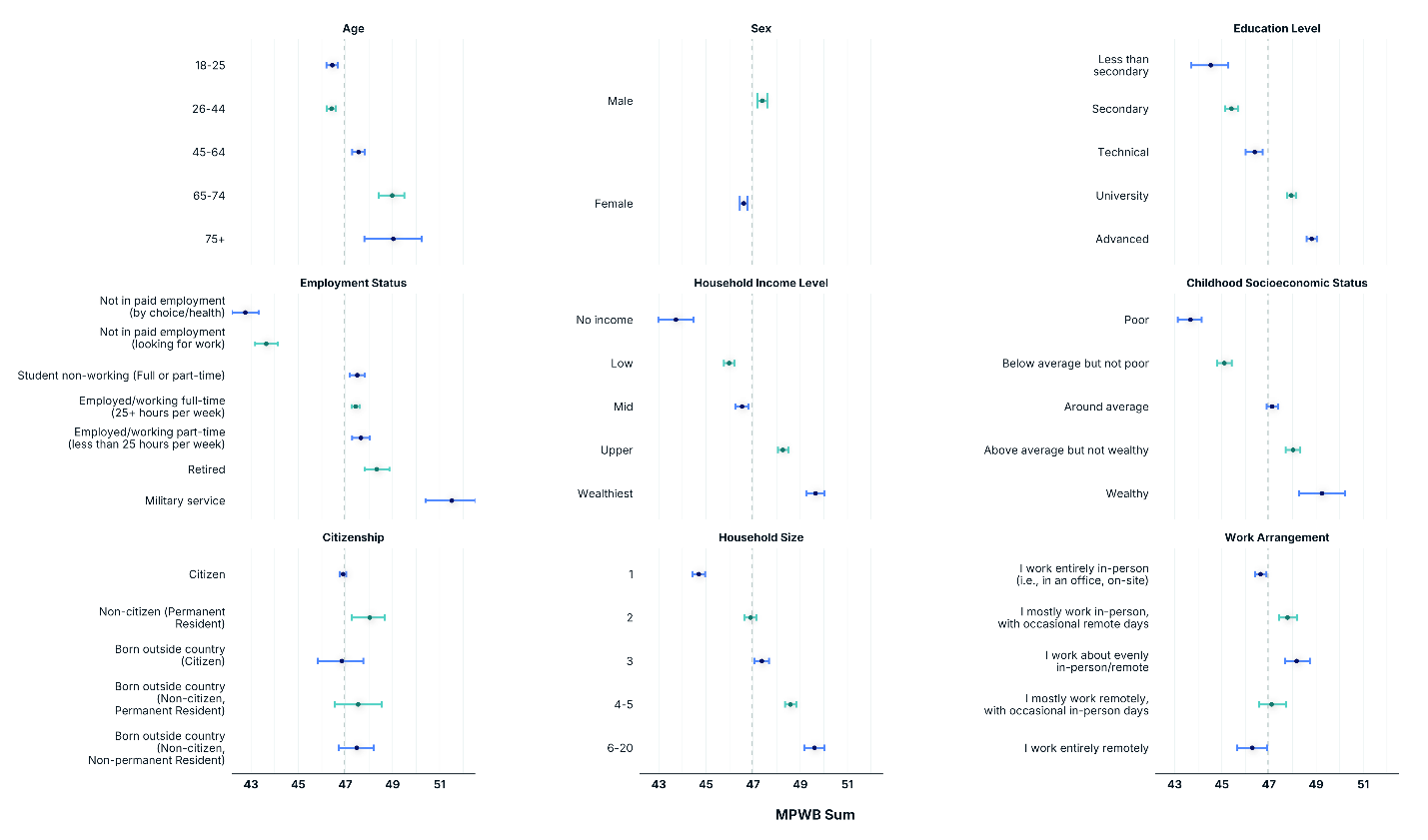
The paper additionally notes that retirees now rating about in addition to working adults and college students in most nations, which wasn’t the case in 2012. I requested Ruggeri whether or not that’s about age or about this technology.
“What’s way more regarding is simply how widespread the low scores for younger adults is,” he stated. He listed a number of attainable causes, from younger individuals being “overburdened and given restricted house to develop at their very own tempo” to social media and “excessive/perpetual peer comparisons.” Then he pointed to 1 factor particularly: “Our personal information primarily factors towards future outlook: messaging towards younger individuals, particularly within the face of AI advances, implies careers and financial alternatives are going away, whereas future outlook was once a main driver of constructive psychological well being in younger individuals.”
Extra money helps, however every step buys much less
On cash, the examine discovered one thing slightly uncomfortable: well-being saved rising with revenue, with no clear level the place extra money stopped serving to. So I requested Ruggeri what meaning for somebody selecting between the next wage and extra free time.
He was cautious. “There are main variations between financial teams,” he stated, so individuals below extra monetary stress most likely want extra money to achieve their happiest level, whereas for greater earners “the marginal achieve… could also be typically much less, even when it continues.” Going from no revenue to a median revenue, and from common to above-average, has massive results on psychological well being, he defined. Going from very rich to extraordinarily rich should assist slightly, nevertheless it takes a a lot greater soar in cash for a smaller achieve.
Right here my very own small a part of the examine comes again in. The funniest a part of translating the survey turned out to be the cash.
The English model requested individuals for his or her family revenue for the yr, in brackets that went all the way in which as much as “Over $200,000”. In Georgia, no one thinks about revenue per yr, so we switched to month-to-month. After which we needed to shrink the numbers. Rather a lot. Our high field ended up as “over 4,000 GEL” a month. That’s about $17,500 a yr at the 2025 common trade charge, which might land you within the second-lowest field of the American model.
That’s not a typo. So when Kai says the primary steps up the revenue ladder matter most, I consider these brackets. For most individuals again house, these are nonetheless the steps that depend.
What you’ll be able to, and might’t, take from the numbers
If you wish to go searching your self, there’s a public International Psychological Wealth dashboard the place you’ll be able to discover the outcomes by nation and group. It was constructed by Sofia Pelica, a PhD candidate in psychology at Vrije Universiteit Amsterdam and the examine’s second contact creator. Ruggeri’s recommendation is price studying earlier than you do.
“These information are meant for common patterns – undoubtedly discover these!” he stated. “Nevertheless it’s most important by no means to deduce any particular discovering.” His advice: “solely word and take away the overall, high-level patterns. However keep away from any particular nation or group comparisons.”
The end result that stunned me most was Georgia’s, possibly as a result of it’s my very own nation and I do know it from the within. Within the paper, it had the best share of individuals above the despair screening cutoff, 46.72%. However Ruggeri’s recommendation applies to me too. The pattern was recruited largely on-line and thru the analysis groups’ personal networks, so it isn’t consultant of any nation. The questions had been answered in 50 languages, and a brief display flags signs, it doesn’t diagnose anybody.
Psychological well being is not only the absence of sickness
My final query to Ruggeri was an even bigger one: what can we, as a society, get most mistaken once we speak about psychological wealth and well-being? Right here’s how his reply started.
“We are saying ‘psychological well being’ however we imply ‘psychological sickness’. Some would possibly assume that’s simply semantics, nevertheless it genuinely issues,” he instructed me. When the dialog shifts to despair, nervousness and different circumstances, “it nearly universally shifts to therapy, whether or not it’s scientific, pharmaceutical, or institutional.” That narrows what we predict we will do, and it mixes up grief tied to a sudden occasion with long-term circumstances like scientific despair. What psychological well being ought to imply, he stated, is “having a way of objective, having good high quality relationships, feeling like what we obtain issues.”
“These can’t be solved by yoga and meditation nor by drugs (alone).” — Kai Ruggeri, Columbia College
The info reveals this too. Individuals with no indicators of despair or nervousness nonetheless diverse quite a bit in how properly they had been doing, and loads of them scored pretty low.
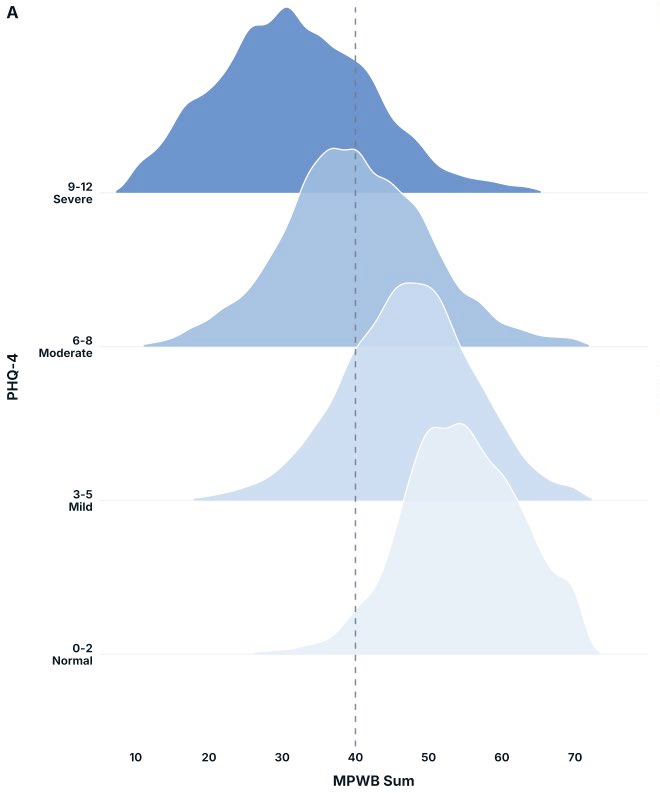
This isn’t solely about how we speak. For many years, psychology itself targeted totally on what goes mistaken with individuals. That’s why, in 2000, Martin Seligman and Mihaly Csikszentmihalyi referred to as for a “constructive psychology”: a science of what makes life price dwelling.
We do the identical with resilience. We are inclined to search for it solely within the exhausting occasions, as if individuals want one thing horrible to occur earlier than they learn how sturdy they’re. However you don’t want a disaster to ask how rapidly somebody bounces again. One of many survey’s ten statements does precisely that.
Perhaps the higher query isn’t what individuals have survived. It’s what will get them away from bed on a standard Monday morning.
There’s rather more on this examine than I may match right here, and the ultimate paper ought to be out quickly. I’m certain I’ll get again to this dialog. Till then, I hope the subsequent time somebody asks how you might be, you concentrate on it for a second longer earlier than saying “nice”. I’ll be over right here, attempting to do the identical.

