

You constructed an MVP in three weeks. Clients are signing up. Your demo works. Traders have an interest.
Then somebody asks for entry to your GitHub repository.
All of a sudden, the dialog adjustments.
Who wrote the code? Which components had been generated by AI? Has a senior engineer reviewed the structure? Are you able to clarify how authentication works? What occurs if the appliance must help 100,000 customers as a substitute of 100?
And maybe probably the most uncomfortable query: What wouldn’t it value to rebuild the components that aren’t production-ready?
Should you constructed your software utilizing Lovable, Cursor, Bolt, or one other AI coding platform, these are questions price answering earlier than an investor asks them.
The issue shouldn’t be that you simply used AI to construct your product. The issue begins when no person can clarify, safe, take a look at, or preserve what AI constructed.
That distinction can affect how traders assess your expertise, how a lot further engineering they anticipate, and what situations they connect to a deal.
Is AI-Generated Code a Pink Flag Throughout Startup Technical Due Diligence?
AI-generated code shouldn’t be robotically a purple flag in technical due diligence. Code that no person can clarify, take a look at, safe, or preserve is. Traders assess whether or not the software program is technically defensible, commercially scalable, and costly to restore. Undocumented AI-generated code can introduce safety vulnerabilities, possession uncertainty, and technical debt that impacts funding choices and acquisition negotiations.
This issues as a result of constructing software program and proudly owning a reliable software program enterprise are two completely different achievements.
A functioning prototype demonstrates that an concept can work. A technically sound product demonstrates that the enterprise can proceed working when the unique builder leaves, buyer demand will increase, or safety necessities turn into extra demanding.
That hole is the place vibe coding technical debt turns into a monetary concern.
Why AI-Generated Code Safety Is Turning into a Severe Due Diligence Query
AI-generated code will be syntactically appropriate, functionally convincing, and insecure on the similar time.
Veracode’s 2026 GenAI Code Safety Report discovered that roughly 44% of the evaluated AI code-generation duties produced code containing a detectable vulnerability related to the OWASP High 10. The examine measured generated outputs beneath particular take a look at situations, not the vulnerability charge of each AI-built software in manufacturing.
Nonetheless, the implication for founders is necessary.
A working software shouldn’t be proof that the underlying code has been security-reviewed.
A separate 2026 examine printed in Empirical Software program Engineering examined 2,315 code snippets from actual developer interactions and recognized 56 confirmed vulnerabilities throughout 48 recordsdata. Even superior AI fashions didn’t establish and restore each concern throughout subsequent testing.
The lesson shouldn’t be that AI-generated software program is inherently worse than human-written software program. Human builders introduce vulnerabilities too.
The lesson is that code provenance, unbiased assessment, and verifiable testing matter no matter who or what created the software program.
For founders, this implies treating AI-generated code as software program that requires engineering accountability, not as an exception to atypical safety practices.
What Do Traders and Technical Reviewers Ask About AI-Generated Code?
There isn’t any common investor guidelines requiring founders to reveal a specific share of AI-generated code. Necessities rely upon the investor, transaction, product, business, and the technical dangers concerned.
Nevertheless, a severe technical due diligence assessment might examine a number of areas.
1. How a lot of the appliance was generated utilizing AI?
A reviewer may ask whether or not Lovable generated the frontend, Cursor assisted with backend performance, or one other AI system produced vital enterprise logic.
The exact share shouldn’t be at all times probably the most helpful measure. Understanding which parts had been generated, modified, reviewed, and examined is extra necessary.
An AI-generated touchdown web page carries a special danger profile from an AI-generated cost authorization service.
2. Who understands and owns the structure?
Can somebody clarify how knowledge strikes by means of the appliance? Why specific frameworks had been chosen? How providers talk? What occurs when a vital dependency fails?
If each architectural query ends with “the AI generated it,” the reviewer has found a data hole.
That hole can translate into further engineering work, slower product improvement, and dependence on exterior specialists.
3. Has the appliance been independently examined?
A profitable deployment doesn’t show that the software program is dependable.
Reviewers might ask for automated take a look at outcomes, safety assessments, error logs, dependency scans, infrastructure documentation, and proof of how defects are resolved.
They wish to know whether or not the appliance behaves predictably exterior the blissful path demonstrated to traders.
4. Are knowledge entry and buyer data protected?
This turns into notably necessary for SaaS, fintech, healthcare, enterprise AI, and purposes dealing with personally identifiable data.
A reviewer might take a look at whether or not one buyer can entry one other buyer’s data, whether or not administrative capabilities are restricted, or whether or not credentials have leaked into browser-accessible code.
These are sensible safety issues with doubtlessly severe business penalties.
5. Can one other engineering group preserve and scale the product?
Traders will not be solely evaluating what has already been constructed. They’re evaluating what it is going to take to construct the subsequent model.
If onboarding a brand new developer requires deciphering 1000’s of strains of unexplained code, the product could also be dearer to scale than the pitch deck suggests.
Traders could also be snug with AI-assisted improvement. They’re much less prone to be snug with engineering danger no person has quantified.
The 5 Vibe Coding Technical Debt Issues Reviewers Can Uncover in Your Repository
Some technical weaknesses are inconvenient. Others can expose buyer knowledge, interrupt operations, or threaten a transaction.
The next are frequent danger classes price investigating in AI-assisted MVPs. They don’t seem to be claims in regards to the prevalence of defects in any particular coding platform.
1. Uncovered API Keys and Secrets and techniques in Consumer-Facet Code
Think about your MVP connects to a cost processor, database, and third-party AI service.
Throughout improvement, an API secret is positioned immediately right into a frontend configuration file to make the combination work. The applying capabilities, so no person revisits the implementation.
Sadly, code delivered to a consumer’s browser shouldn’t be a protected place for confidential credentials.
A technical reviewer might examine bundled JavaScript, repository historical past, surroundings configuration, and entry insurance policies to establish uncovered credentials.
Why it issues: Uncovered secrets and techniques can enable unauthorized API utilization, sudden expenses, entry to delicate sources, or different safety incidents.
What to repair: Transfer confidential operations to trusted server-side parts, use managed secret storage, prohibit privileges, rotate uncovered credentials, and look at repository historical past. Eradicating a key from the newest commit doesn’t invalidate copies already uncovered.
2. Lacking Authorization Behind a Working Login Display
A login display shouldn’t be proof of safe authorization.
Contemplate a SaaS dashboard the place an authenticated consumer can retrieve one other buyer’s data by altering an identifier in an API request.
The applying accurately acknowledges the consumer however fails to confirm whether or not that consumer has permission to entry the requested data.
It is a damaged object-level authorization downside, typically known as BOLA or IDOR.
Why it issues: Cross-customer knowledge publicity can create safety, contractual, regulatory, and reputational dangers.
What to repair: Implement authorization on the server for each protected operation, validate entry on the useful resource stage, and take a look at customers with completely different roles and tenant memberships.
For multi-tenant SaaS merchandise, this ought to be a precedence earlier than a fundraising data-room assessment.
3. No Automated Exams for Important Enterprise Workflows
Your MVP works when the founder clicks by means of it.
However what occurs when a subscription renews twice, a cost fails, an exterior API occasions out, or two customers modify the identical report concurrently?
AI coding instruments can generate assessments, however assessments should nonetheless be chosen, reviewed, executed, and maintained. They need to validate enterprise conduct fairly than merely verify that code runs.
A repository with little take a look at protection might point out that necessary adjustments can’t be made safely.
Why it issues: Traders might anticipate increased regression danger, slower releases, extra handbook QA, and extra prices to stabilize the appliance.
What to repair: Prioritize integration and automatic assessments round authentication, authorization, funds, buyer knowledge, and revenue-generating workflows. Add significant unit assessments the place they cut back danger.
The variety of assessments issues lower than the vital behaviors they really confirm.
4. Duplicated Logic and Unclear Software Structure
You requested your AI coding instrument so as to add a function. It created a brand new perform as a substitute of reusing an current one.
You requested for a second dashboard. It generated one other set of database queries.
You modified the subscription logic, however the outdated model nonetheless exists in a special module.
Individually, these adjustments could seem innocent. Over time, they will produce inconsistent enterprise guidelines, troublesome debugging, and more and more costly function improvement.
Why it issues: Upkeep complexity can improve engineering prices and cut back the velocity at which a startup can ship its roadmap.
What to repair: Establish duplicated enterprise logic, set up clear module boundaries, consolidate shared providers, doc architectural choices, and refactor high-change areas.
The target is to not make each file elegant. It’s to make sure that future improvement doesn’t turn into progressively dearer.
5. Uncontrolled Dependencies and Unclear Licensing
AI-generated purposes can incorporate third-party packages, templates, libraries, and generated parts.
A bundle could also be outdated, pointless, susceptible, or topic to a license that requires further assessment.
Not each dependency downside is a authorized or safety disaster. However a founder who can’t establish the appliance’s dependencies, licenses, and possession boundaries creates uncertainty throughout diligence.
Why it issues: Weak dependencies might have substitute, whereas licensing or mental property questions might require authorized assessment or further documentation.
What to repair: Stock direct and transitive dependencies, generate a software program invoice of supplies the place acceptable, scan for recognized vulnerabilities, assessment relevant licenses, and set up a documented approval course of.
That is notably necessary when a startup is coming into enterprise procurement or acquisition discussions.
How Vibe Coding Technical Debt Can Have an effect on Startup Valuation
Right here is the query founders really need answered:
Will traders cut back my valuation as a result of I used AI to construct my MVP?
Not merely since you used AI.
Traders usually consider the chance and economics of the enterprise, together with the price of sustaining, securing, and scaling its expertise.
Weaknesses found throughout technical due diligence might affect the transaction by means of further remediation prices, delayed closing, revised deal situations, retention of funds, or diminished confidence within the enterprise.
Not each discovering adjustments the worth. Some are cheap to resolve. Others have an effect on the assumptions supporting the funding.
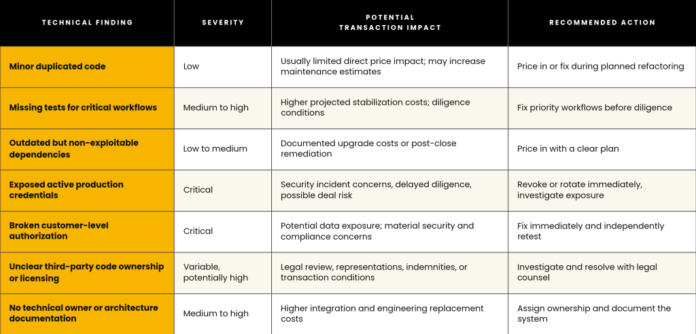
Findings-to-Value-Impression Desk: What Traders Could Do With Technical Debt

Severity and transaction impacts are illustrative. Precise implications rely upon exploitability, buyer publicity, contractual obligations, deal construction, investor danger tolerance, and the price of remediation.
What Does Technical Debt Do to the Numbers?
Contemplate a hypothetical startup discussing a $5 million valuation.
Throughout diligence, an unbiased engineering evaluation identifies $120,000 of obligatory stabilization and safety work.
The investor may ask the founder to finish the work earlier than closing, negotiate a special valuation, reserve funds for remediation, or proceed with a contractual situation.
However the existence of $120,000 in technical debt doesn’t robotically imply the valuation falls by $120,000.
The monetary impression will depend on whether or not that work was already anticipated, how urgently it have to be accomplished, whether or not it creates enterprise interruption danger, and the way the deal is structured.
A helpful solution to consider technical debt is to think about 4 parts:
Remediation value + operational publicity + future upkeep burden + execution uncertainty.
These will not be interchangeable or mechanically additive. They signify the other ways an engineering concern can affect business judgment.
A minor refactoring activity may not materially have an effect on negotiations. A vulnerability permitting unrestricted buyer knowledge entry might have penalties far past the price of fixing the code.
That’s the reason founders ought to quantify and prioritize technical debt earlier than coming into a transaction.
Repair Now, Value In, or Deal Threat: How Ought to Founders Prioritize Findings?
The target of pre-investment code cleanup is to not rebuild the whole software. It’s to eradicate unacceptable dangers and create a reputable plan for the whole lot else.
Repair Now: Points That Threaten Safety or Enterprise Continuity
Energetic uncovered credentials, damaged authorization, exploitable safety vulnerabilities, and defects affecting cost or buyer knowledge integrity belong on this class.
These issues ought to be handled as pressing as a result of continued operation might expose the corporate or its clients to quick hurt.
For reside safety points, containment and incident evaluation take priority over the fundraising timeline.
Value In: Manageable Debt With Identified Remediation Prices
Duplicated logic, maintainability points, documentation gaps, and sure dependency upgrades could also be manageable if they’re nicely understood.
They need to have an recognized proprietor, life like value estimate, enterprise impression evaluation, and goal remediation date.
The necessary distinction is between acknowledged technical debt and unknown technical debt.
An investor might settle for a documented enchancment plan extra readily than an assurance that no issues exist.
Deal Threat: Points That Make Possession or Operation Unsure
Unresolved mental property questions, severe safety incidents, unverified buyer knowledge isolation, or a system that can not be operated and not using a specific particular person can create substantial diligence issues.
These might require specialist assessment, authorized involvement, important remediation, or adjustments to the transaction construction.
The appropriate response is proof, not reassurance.
The right way to Clear Up a Vibe-Coded MVP in 10 Working Days Earlier than Fundraising
A centered 10-day cleanup dash can establish vital dangers, resolve an outlined set of high-priority findings, and put together documentation for a technical due diligence assessment.
It’s not a assure that each software will be made production-ready in 10 days. The scope will depend on software complexity, entry to the codebase, take a look at environments, and the severity of found points.
For a comparatively small MVP with a functioning construct, an organized engineering group can use the next method.
Day 1: Set up Repository Possession and System Boundaries
Establish all supply repositories, manufacturing environments, deployment platforms, databases, integrations, and privileged accounts.
Doc the appliance’s fundamental structure and make sure who controls the supply code, infrastructure, domains, and important vendor relationships.
The end result ought to be a transparent understanding of what the corporate owns and operates.
Day 2: Construct the AI Code Provenance Stock
Document which improvement instruments had been used and which components of the appliance had been considerably generated or modified with AI help.
Establish business-critical parts, their present maintainers, and whether or not they have undergone human assessment.
The place dependable code-generation metrics are unavailable, classify involvement as AI-generated, AI-assisted, human-authored, or unknown fairly than inventing percentages.
Day 3: Run Secret and Dependency Scanning
Scan the repository and related historical past for credentials, tokens, personal keys, and unsafe configurations.
Establish susceptible dependencies, unsupported packages, and licensing issues.
Instantly revoke or rotate confirmed uncovered credentials. Don’t postpone lively safety dangers till the tip of the dash.
Day 4: Check Authentication and Authorization
Evaluate login mechanisms, session dealing with, entry management, API permissions, and administrative capabilities.
Check whether or not customers can entry data or operations belonging to different accounts or tenants.
Use established software safety verification necessities as a baseline and validate findings by means of licensed testing.
Day 5: Look at Structure and Information Integrity
Map key providers, database relationships, vital workflows, and exterior dependencies.
Search for duplicated enterprise guidelines, fragile integrations, lacking database constraints, unhandled failures, and areas the place architectural assumptions are unclear.
Prioritize points that might trigger knowledge corruption, buyer disruption, or costly rework.
Day 6: Set up Automated Testing for Important Paths
Create or restore assessments for the workflows that matter most to clients and income.
Give attention to registration, authentication, authorization, billing, knowledge entry, and core product performance.
Seize baseline outcomes and distinguish newly added assessments from people who had been already passing.
Day 7: Remediate Excessive-Precedence Findings
Implement focused fixes for points recognized in the course of the first six days.
Keep away from broad rewrites except a selected part presents unacceptable danger and incremental remediation is impractical.
Use peer assessment, managed adjustments, and repeatable testing to confirm the fixes.
Day 8: Validate Construct, Deployment, and Operational Restoration
Verify that one other engineer can construct, deploy, and troubleshoot the appliance.
Evaluate surroundings separation, backup procedures, restore functionality, logging, monitoring, and incident-response possession.
A product that works solely in its authentic developer’s surroundings shouldn’t be prepared for a severe operational evaluation.
Day 9: Conduct an Unbiased Engineering Evaluate
Have a senior engineer who didn’t implement the adjustments assessment the vital findings, code modifications, take a look at proof, and unresolved dangers.
Retest remediated vulnerabilities and make sure whether or not they’re genuinely closed.
Document any remaining limitations as a substitute of labeling untested parts as safe.
Day 10: Put together the Investor-Prepared Technical Due Diligence Report
Consolidate the structure abstract, code provenance stock, safety findings, remediation proof, take a look at outcomes, dependency stock, and excellent technical debt.
Separate accomplished fixes from deliberate work.
The ultimate report ought to clarify what was evaluated, the way it was evaluated, what stays unsure, and which dangers the founder has accepted or plans to resolve.
The target is to not declare that the software program is ideal. It’s to reveal that the enterprise understands and controls its engineering dangers.
How ISHIR Helps Founders Put together Vibe-Coded MVPs for Investor Due Diligence
At ISHIR, we assist founders transfer from a working AI-built prototype to a codebase that may stand up to structured technical assessment.
Our method begins with a pre-diligence evaluation. Senior engineers look at the appliance’s structure, vital supply code, authentication and authorization, dependencies, safety controls, testing practices, and deployment readiness. As an alternative of instantly recommending a rewrite, we establish the problems that current actual enterprise danger and distinguish them from maintainability enhancements that may be scheduled later.
By ISHIR’s Vibe Coding Cleanup Companies, founders can get skilled engineering oversight with out discarding the velocity benefit that helped them launch.
The end result is a stronger technical basis and clearer proof for conversations with traders, acquirers, enterprise clients, and incoming engineering leaders.
Will Your Vibe-Coded MVP Survive Investor Due Diligence?
ISHIR helps founders uncover technical debt, repair vital safety gaps, and put together investor-ready engineering stories earlier than fundraising.
Steadily Requested Questions About Vibe Coding Technical Debt and Due Diligence
Q. Is AI-generated code a purple flag in technical due diligence?
Not robotically. Traders and technical reviewers are usually extra involved with safety, maintainability, software program possession, and operational danger than the id of the code creator. AI-generated code turns into a priority when it lacks ample testing, assessment, documentation, or safety controls.
Q. Do traders examine how a lot code AI wrote?
Some traders or technical reviewers might ask in regards to the extent and goal of AI-assisted improvement, however there is no such thing as a common share threshold. They might look at vital parts, code historical past, possession, and assessment processes. A component-level provenance report is usually extra helpful than an unsupported estimate of complete AI-generated code.
Q. How lengthy does it take to wash up a vibe-coded MVP earlier than a elevate?
A centered 10-working-day dash could also be sufficient to audit a small MVP, repair chosen vital issues, introduce important assessments, and create a technical diligence report. Bigger techniques, important safety weaknesses, or architectural issues might require a number of further weeks or extra. The timeline ought to be based mostly on an preliminary evaluation.
Q. Can vibe coding technical debt cut back startup valuation?
Sure, doubtlessly. Technical weaknesses can improve projected remediation prices, create safety and continuity dangers, or cut back investor confidence. They might affect valuation discussions, transaction situations, or closing timelines. Nevertheless, there is no such thing as a normal low cost utilized just because a startup used AI coding instruments.
Q. Ought to I rewrite my Lovable, Cursor, or Bolt software earlier than fundraising?
Not with out first assessing the present system. Many AI-assisted purposes will be improved by means of focused safety fixes, testing, documentation, and architectural refactoring. A whole rewrite could also be justified when structural issues make protected upkeep impractical, but it surely shouldn’t be the default suggestion.
Q. What’s the greatest safety danger in a vibe-coded SaaS software?
There isn’t any single highest danger for each software. Uncovered credentials, damaged authorization, weak tenant isolation, insecure knowledge entry, and susceptible dependencies are necessary areas to evaluate. Probably the most severe concern will depend on what an attacker might exploit and which knowledge or enterprise operations might be affected.
Q. What paperwork ought to founders put together for technical due diligence?
A helpful documentation bundle contains an structure diagram, repository and infrastructure stock, AI Code Provenance Log, dependency stock, license assessment, safety evaluation, automated take a look at proof, deployment documentation, and a prioritized remediation register. The bundle ought to distinguish verified outcomes from assumptions or deliberate enhancements.
Q. Can non-technical founders move technical due diligence?
Sure. A founder doesn’t must personally perceive each line of code, however the firm wants accountable technical possession and credible proof of software program high quality. Unbiased senior engineers can assess the system, doc its dangers, remediate vital points, and assist put together a defensible technical diligence report.

