

Anthropic was based in 2021 to make sure humanity can management AI and profit from it within the long-term. Because the frontier lab approaches its preliminary public providing, nonetheless, there’s one class of humanity that’s being shut uncontrolled: anybody who buys its inventory on public markets.
Complicated constructions that permit founders like Elon Musk or Mark Zuckerberg to manage their public corporations with out proudly owning most of them are nothing new in Silicon Valley. However Anthropic’s obsession with AI security has resulted in a very baroque model of company governance that can depart frequent shareholders with little say over most main choices on the AI firm, together with who sits on its board.
First, Anthropic is a public profit firm — a for-profit company legally allowed to weigh a public mission alongside revenue — with the aim of selling AI security. That standing protects the board’s means to make choices about AI security that aren’t pushed completely by shareholder worth with out being sued by offended traders.
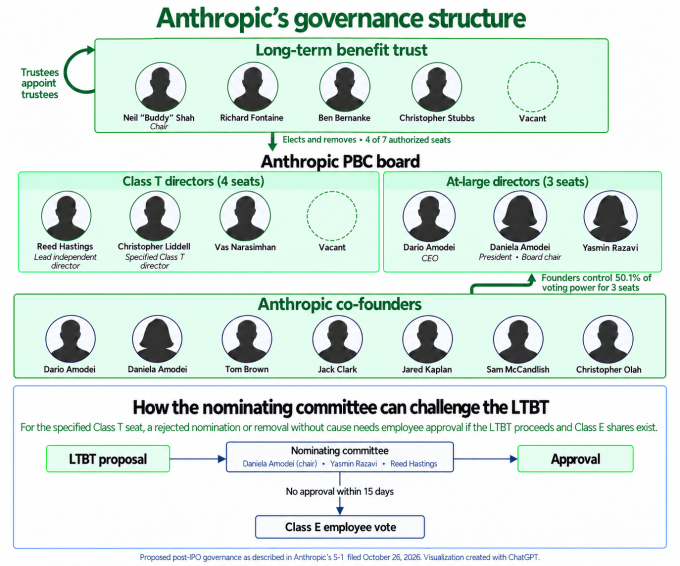
Proper now, the board is chaired by Anthropic president Daniela Amodei and consists of CEO Dario Amodei (her brother), Netflix cofounder Reed Hastings, former Microsoft and GM CFO Christopher Liddell, Novartis CEO Vas Narasimhan, and Spark Capital associate Yasmin Razavi. There may be one emptiness on the board.
Second, Anthropic has allotted important management of its board to a Lengthy-Time period Profit Belief (LTBT), an impartial panel meant to maintain the corporate targeted on mission to profit humanity. The belief owns a category of inventory that offers it the flexibility to elect and take away a majority of the corporate’s board, often called Class T administrators. The LTBT is chaired by Neil Shah, a world well being skilled who was managing director at GiveWell, a nonprofit that ranks charities, and consists of former Federal Reserve chair Ben Bernanke, nationwide safety skilled Richard Fontaine, and Harvard physicist Christopher Stubbs. There may be one emptiness on the LTBT proper now. The present members will themselves select who fills it.
Third, Anthropic’s seven founders additionally collectively personal a particular class of inventory that offers a majority of them 50.1% of shareholder voting energy, permitting them to elect three members of the board of administrators. If, for no matter cause, there’s no majority among the many founders, solely then are their shares voted in proportion with holders of frequent inventory.
Lastly, the board can put a verify on the LTBT. When the LTBT nominates a “Specified” considered one of its 4 administrators, or removes that director with out trigger (that’s, with out alleging misconduct), the board’s nominating committee can decline to approve the transfer and throw the choice to the corporate’s workers for a vote.
Right here’s what all that appears like:

The dynamics of such a fancy construction are arduous to foretell. We’ve already seen one notable occasion the place an analogous construction was primarily overthrown: OpenAI’s so-called blip, when OpenAI’s board briefly fired CEO Sam Altman over issues that he was not being candid with them. Because of the loyalty of the corporate’s workers to Altman, the board backed down, reinstated him, and a brand new governance construction was put in place. Anthropic’s construction appears to formalize that type of worker energy.
At Anthropic, cracks within the founders’ unified entrance might result in frequent shareholders having extra say than anticipated, whereas workers can overrule the LTBT on board seats in the event that they again the board over the assembled luminaries.
The founders’ management received’t final endlessly: Ten years after the IPO, the founders can select to finish their management of the corporate, or their management will finish robotically when fewer than three of them stay. At that time, the LTBT will proceed till 85% of frequent shareholders vote to finish it, or it decides to step down with approval from the board.
If and when neither particular class of shareholder exists any extra — hopefully not due to an AI-driven disaster — frequent shareholders lastly get management.
While you buy via hyperlinks in our articles, we could earn a small fee. This doesn’t have an effect on our editorial independence.

