

Your ambient AI pilot works. Physicians prefer it. Medical notes are generated in minutes. Documentation time is coming down.
Then somebody asks a query that adjustments every little thing.
“If the AI is documenting your entire affected person encounter, why are our clinicians nonetheless copying info into the EHR, updating orders manually, and switching between three completely different programs?”
That’s the place the actual problem begins.
For healthcare CIOs, CTOs, CMIOs, and know-how leaders, ambient listening in healthcare is not merely about turning conversations into scientific notes. The true alternative is connecting these conversations to the programs answerable for affected person care.
And that’s the place many promising implementations run into hassle.
Your hospital may use Epic. One other facility in your community runs Oracle Well being, previously Cerner. An acquired specialty observe nonetheless is determined by a legacy digital well being document system with restricted integration capabilities.
Changing these programs would imply disrupting established scientific workflows, retraining 1000’s of customers, migrating delicate affected person knowledge, and taking over substantial operational threat.
Thankfully, you don’t have to interchange your EHR to make ambient AI work.
With the proper healthcare interoperability structure, APIs, HL7 FHIR integration, and EHR-specific workflow engineering, healthcare organizations can combine ambient listening AI into their current scientific infrastructure.
The problem is realizing what to attach, find out how to join it, and the place automation ought to cease.
What Is Ambient Listening in Healthcare, and How Does It Combine With EHR Methods?
Ambient listening in healthcare makes use of AI-powered speech recognition and pure language processing to seize clinician-patient conversations and generate draft scientific documentation. EHR integration connects that info to the affected person’s medical document, scientific workflows, and approved care groups with out requiring clinicians to manually re-enter it.
A typical ambient AI system captures a certified affected person encounter, distinguishes audio system, identifies clinically related info, and produces a structured draft word.
Nonetheless, producing the word is just one a part of a scientific workflow.
Think about a routine main care appointment.
A affected person experiences persistent fatigue. The doctor discusses potential causes, opinions drugs, recommends laboratory testing, and schedules a follow-up go to.
An ambient AI software may doc that encounter precisely.
However what occurs subsequent?
- Does the word attain the right affected person and encounter in Epic?
- Does the doctor see the draft within the current documentation workflow?
- Can the really helpful laboratory check be ready for clinician overview?
- Is the follow-up instruction related to the suitable workflow?
- Does the documentation retain the right writer, timestamp, and scientific context?
- Can the system distinguish between what the affected person mentioned and what the doctor truly determined?
If these steps nonetheless require guide intervention, the group has improved documentation however has not absolutely improved the scientific workflow.
Ambient listening turns into extra useful when the data it captures can transfer safely by current healthcare programs.
That requires greater than a speech-to-text API.
It requires healthcare interoperability.
Why Ambient Listening in Healthcare Usually Fails to Scale Past a Profitable Pilot
The primary hundred encounters could make an ambient AI implementation look simple.
A small group of physicians assessments the applying. Notes are generated. Suggestions is constructive. Management begins making ready an enterprise rollout.
Then IT discovers that the pilot has solely solved one a part of a a lot bigger downside.
1. Ambient AI Generates Notes, however the EHR Can not Use Them Correctly
Many ambient AI merchandise can generate SOAP notes, encounter summaries, and scientific narratives.
However producing a readable word doesn’t imply the receiving EHR can course of it appropriately.
Completely different EHR platforms have completely different necessities for word varieties, scientific context, writer attribution, doc standing, and workflow permissions.
A doc that works in a single setting could be rejected, incorrectly categorized, or filed in an unsuitable location in one other.
For instance, an AI-generated word could also be seen in a affected person’s chart however unavailable within the doctor’s most popular documentation workflow.
Technically, the mixing succeeded.
Operationally, it failed.
The answer: Design integration across the receiving EHR’s precise scientific workflow, supported assets, authorization necessities, and word lifecycle, relatively than assuming that importing a doc is adequate.
2. Your Hospital Operates A number of EHR Methods That Do Not Talk Persistently
A well being system might need Epic in its flagship hospitals, Oracle Well being in regional amenities, and older functions in specialty clinics.
These programs could symbolize scientific info otherwise.
Affected person identifiers, encounter IDs, word classifications, terminology, and doc statuses can differ.
In case your ambient AI platform is constructed round one EHR’s inner mannequin, each extra integration turns into a customized engineering venture.
The answer: Introduce a healthcare integration layer that normalizes supported scientific info into a standard inner mannequin and interprets it into every vacation spot system’s required format.
This doesn’t remove EHR-specific improvement, however it reduces pointless duplication.
3. Your AI System Can Learn Affected person Knowledge however Can not Write It Again
This is likely one of the most vital technical limitations to analyze earlier than buying or creating an ambient AI resolution.
FHIR assist doesn’t mechanically imply full read-and-write interoperability.
An EHR could expose affected person demographics, encounters, allergic reactions, and drugs by standardized APIs whereas proscribing how exterior functions create scientific notes or submit orders.
Some capabilities require extra authorization, organization-specific configuration, or vendor-supported integration mechanisms.
The answer: Consider learn, create, replace, and workflow capabilities individually. Take a look at the precise operations required for the use case earlier than approving enterprise deployment.
4. Clinicians Nonetheless Need to Reconcile AI Output With Current Workflows
Think about an ambient AI software captures a doctor’s suggestion to vary a drugs.
The software identifies the medicine, dosage, and frequency.
That doesn’t imply it ought to mechanically change the affected person’s prescription.
Treatment selections depend upon scientific context, verified affected person info, allergic reactions, contraindications, {and professional} judgment.
An integration that mechanically converts each spoken suggestion into an executable order may introduce critical affected person security dangers.
The answer: Separate scientific intent extraction from approved scientific motion. AI can put together structured info or draft orders, however the applicable licensed clinician should overview and approve high-risk actions.
The target shouldn’t be most automation.
It’s dependable automation that preserves scientific accountability.
Learn how to Combine Ambient Listening AI With Epic EHR
Epic is a significant EHR platform throughout US well being programs, making Epic integration a standard requirement for enterprise ambient AI initiatives.
The excellent news is that organizations don’t essentially want to interchange Epic or develop a completely separate documentation platform.
Epic gives interoperability capabilities by FHIR APIs and different supported integration mechanisms.
Its public technical specs embrace FHIR R4 operations for scientific notes, together with DocumentReference creation, studying, and looking out.
Nonetheless, availability of a particular interface doesn’t assure that each Epic buyer setting exposes the identical performance or permissions.
Step 1: Set up the Right Epic Integration Mannequin
Begin by figuring out how clinicians will entry ambient AI.
Will they launch the applying from their Epic workflow? Will the applying function as an embedded or context-aware expertise? Or will a background service trade permitted knowledge with out requiring customers to open a separate interface?
Relying on the use case and supported capabilities, a SMART on FHIR strategy can present authenticated entry and scientific context.
The mixing crew ought to set up:
- Software registration and the required organizational approvals.
- OAuth 2.0 authorization and applicable SMART scopes.
- Entry to the right affected person and encounter context.
- Supported FHIR assets and operations.
- Clinician id and entry permissions.
- Word submission, overview, and signing necessities.
The vital choice is whether or not clinicians can use ambient AI with out disrupting the workflow they already comply with.
Step 2: Join Ambient Listening AI With Epic Medical Knowledge
An ambient AI software could require entry to related affected person context, comparable to drugs, allergic reactions, encounters, and documented medical historical past.
Relying on accessible permissions and APIs, the mixing can use FHIR assets comparable to Affected person, Encounter, MedicationRequest, AllergyIntolerance, and Situation.
This context helps the applying produce extra helpful drafts and determine info that requires verification.
However entry ought to comply with the minimal essential precept the place relevant.
The applying mustn’t retrieve a whole affected person document when the scientific workflow solely requires a restricted set of knowledge.
Step 3: Map AI-Generated Notes to Epic’s Supported Documentation Interfaces
That is the place EHR-specific engineering turns into vital.
Suppose ambient AI produces a progress word.
Earlier than transferring that word, the mixing should decide the suitable scientific doc sort, affected person identifier, encounter affiliation, writer, and doc standing.
FHIR DocumentReference could present a supported mechanism for creating or retrieving scientific paperwork.
Nonetheless, the mixing should validate whether or not the goal Epic configuration helps the required note-creation workflow and the way imported content material is reviewed and signed.
A profitable API response alone doesn’t show that the word is appropriately positioned throughout the clinician’s workflow.
Step 4: Protect Medical Evaluation Earlier than Finalization
Ambient AI mustn’t bypass scientific documentation approval.
The system ought to assist a managed course of during which the clinician opinions, corrects, and approves the generated documentation earlier than finalization.
This requires cautious dealing with of draft states, revisions, writer attribution, and signing workflows.
The place an EHR API doesn’t assist the specified draft lifecycle, the applying may have to take care of its personal safe overview workflow and use an permitted EHR mechanism for last submission.
The mixing have to be designed round precise vendor capabilities relatively than assumed performance.
For healthcare know-how leaders, the objective is straightforward: Make ambient AI work inside Epic, not pressure clinicians to work round one other disconnected software.
Reference: Epic’s official FHIR interface specs
Learn how to Combine Ambient Listening AI With Oracle Well being EHR
Organizations utilizing Oracle Well being face the same problem, however the integration particulars are usually not equivalent.
Oracle Well being’s Millennium platform gives FHIR R4 APIs and EHR-specific interfaces for accessing scientific info.
Its revealed API documentation contains operations involving affected person information, encounters, paperwork, and different scientific assets.
Importantly, Oracle Well being additionally paperwork a FHIR R4 DocumentReference create operation.
That creates an integration path price investigating for ambient AI documentation.
Nonetheless, there’s a important technical distinction.
Oracle Well being’s documented DocumentReference create operation helps last documentation for provider-authorized entry, relatively than an unrestricted draft-note workflow.
A healthcare group mustn’t assume that making a doc by an API is equal to putting an unsigned ambient AI draft into its native clinician overview course of.
A Sensible Oracle Well being Ambient AI Integration Strategy
First, set up the affected person and encounter context by supported interfaces.
Second, retrieve solely the scientific info wanted by the ambient AI software.
Third, generate structured documentation utilizing the approved affected person encounter.
Fourth, make the output accessible for clinician overview by an permitted workflow.
Fifth, submit the suitable doc by supported Oracle Well being mechanisms after the required overview and authorization.
Lastly, confirm that the doc seems within the anticipated location with right affected person, encounter, writer, and standing info.
For extra superior performance, comparable to order preparation or workflow triggers, the crew should individually validate every supported API and scientific permission.
Oracle Well being has additionally expanded its personal AI capabilities for scientific documentation and workflow help.
Meaning healthcare CIOs ought to consider whether or not their necessities are greatest dealt with by native options, third-party integration, or a personalized software.
The choice ought to depend upon workflow necessities, extensibility, price, and scientific governance.
Learn how to Combine Ambient Listening in Healthcare With Legacy EHR Methods
Legacy EHR integration is commonly tougher as a result of older programs could not assist trendy FHIR APIs.
Some nonetheless depend upon HL7 v2 messaging, proprietary interfaces, database exports, or tightly managed integration engines.
Others assist restricted interoperability however lack the capabilities required for contemporary ambient AI workflows.
This raises a well-known query for healthcare CIOs:
“Do we have to exchange our legacy EHR earlier than introducing ambient AI?”
In lots of circumstances, no.
A well-designed integration layer can join newer ambient AI functions to older scientific programs with out requiring a full EHR substitute.
Strategy 1: Use HL7 v2 Interfaces The place Supported
HL7 v2 stays extensively utilized in healthcare interoperability.
Relying on the system, supported messages could present entry to affected person administration occasions, scientific observations, or sure doc workflows.
For instance, ADT messages may help keep affected person and encounter context, whereas some programs use MDM messages for medical doc trade.
The exact implementation is determined by the legacy EHR’s interface specs and licensed capabilities.
Strategy 2: Construct an API Integration Layer
If the legacy software lacks appropriate APIs, an integration service can present a managed interface between the ambient AI platform and the EHR’s supported inbound mechanisms.
This layer can carry out knowledge validation, terminology mapping, message transformation, authentication, logging, and supply monitoring.
For instance:
Ambient AI generates a structured scientific word.
The mixing layer validates the affected person and encounter.
The system maps the content material right into a doc format supported by the vacation spot EHR.
The word is then delivered by an permitted interface and routed for the required scientific overview.
This permits the ambient AI software to evolve with out tightly coupling it to each inner element of the legacy platform.
Strategy 3: Use Healthcare Integration Engines
Healthcare integration engines may help orchestrate knowledge motion throughout programs utilizing completely different protocols and codecs.
Relying on the present know-how setting, instruments comparable to NextGen Join or enterprise integration platforms could assist the required interfaces.
The vital consideration shouldn’t be the mixing engine itself.
It’s whether or not the structure gives dependable message supply, traceability, safety, and scientific knowledge integrity.
Strategy 4: Use Managed Alternate options When Fashionable APIs Are Unavailable
Some legacy EHRs supply no appropriate standards-based write interface.
In these environments, organizations could consider vendor-supported file interfaces, doc import mechanisms, or different permitted integration approaches.
Display screen-level automation needs to be thought of solely when supported interfaces are unavailable and the operational dangers could be adequately managed.
Direct database writes into an EHR shouldn’t be handled as a shortcut. They might bypass validation, audit controls, and vendor-supported scientific workflows.
The fitting legacy modernization technique shouldn’t be essentially changing every little thing. It’s making a secure interoperability path whereas preserving the programs that also assist affected person care.
The Structure Behind Scalable Ambient Listening in Healthcare
A scalable ambient listening implementation wants greater than a connection between a microphone and an EHR.
It wants a dependable structure that separates scientific info seize, AI processing, integration, and approved EHR actions.
A sensible structure includes six layers.
Layer 1: Approved Medical Dialog Seize
The system captures an encounter solely below the healthcare group’s relevant authorization, privateness, and consent insurance policies.
Audio seize have to be ruled by applicable safety controls and retention guidelines.
Layer 2: Speech Recognition and Medical AI Processing
The ambient AI software converts approved speech into textual content, distinguishes audio system, identifies scientific ideas, and generates a draft word.
The system ought to determine uncertainty relatively than silently invent lacking info.
Layer 3: Medical Context and Validation
Related EHR context is retrieved by permitted interfaces.
The applying checks identifiers, terminology, encounter affiliation, and any accessible supporting scientific knowledge.
AI-generated info stays distinguishable from verified EHR info.
Layer 4: Healthcare Interoperability Middleware
This layer connects the ambient AI product to the receiving scientific programs.
It could use FHIR R4 APIs, SMART on FHIR authorization, HL7 v2 messages, or permitted vendor-specific interfaces.
It additionally handles transformations, routing, retries, exception administration, and audit occasions.
Layer 5: Clinician Evaluation and Workflow Orchestration
Earlier than the system submits delicate scientific actions, the suitable clinician opinions and approves them.
Documentation, orders, referrals, and follow-up duties needs to be dealt with in response to their particular person workflows and threat ranges.
Layer 6: EHR Integration and Operational Monitoring
The mixing writes or transfers permitted info utilizing supported interfaces.
Operational monitoring confirms that info reached the right system, affected person, encounter, and workflow vacation spot.
That is notably vital when a well being system operates a number of EHR platforms.
The structure should account for failed messages, duplicate submissions, unavailable interfaces, and interrupted encounters.
An enterprise-ready ambient AI system must know not simply what info was generated, however whether or not that info arrived safely and appropriately.
The Seven-Step Course of for Integrating Ambient Listening AI With out Changing Your EHR
Healthcare organizations ought to strategy integration as a staged engineering initiative, not a standalone software program set up.
Step 1: Audit the Current EHR and Medical Workflow Atmosphere
Establish each EHR platform concerned, the scientific departments utilizing it, present integration interfaces, and current workflow dependencies.
Doc the place affected person info originates, the place notes are reviewed, and which programs obtain downstream scientific knowledge.
The end result needs to be a transparent image of what already works and the place interoperability gaps exist.
Step 2: Outline the Precise Outcomes Ambient AI Should Ship
Don’t begin with a listing of AI options.
Begin with the operational downside.
Are physicians spending extreme time on documentation?
Are scientific notes being copied between functions?
Are follow-up duties being missed or duplicated?
Is poor integration stopping the group from increasing an in any other case profitable pilot?
Translate every problem right into a measurable goal.
For instance, lowering duplicate knowledge entry could also be a extra helpful goal than growing the variety of AI-generated notes.
Step 3: Conduct an EHR API and Integration Feasibility Evaluation
Verify precisely what the goal EHR permits.
Take a look at authentication, entry permissions, supported FHIR assets, doc creation, encounter affiliation, and required clinician overview.
For legacy programs, consider accessible HL7 interfaces and doc import mechanisms.
This step ought to occur earlier than committing to an enterprise implementation roadmap.
Step 4: Design a Vendor-Impartial Integration Structure
The place a number of EHRs are concerned, develop reusable parts for id mapping, terminology translation, scientific word processing, audit logging, and exception dealing with.
Hold EHR-specific adapters separate from the core ambient AI software the place sensible.
This makes future platform upgrades and extra integrations simpler to handle.
Step 5: Implement Medical Security, Privateness, and Safety Controls
Ambient AI workflows deal with extremely delicate affected person info.
The group should assess relevant HIPAA necessities, enterprise affiliate agreements, entry controls, encryption, auditability, and incident response.
Affected person consent necessities additionally must account for relevant federal and state legal guidelines, together with related recording and privateness necessities.
Medical safeguards should embrace applicable human overview and procedures for correcting inaccurate documentation.
Step 6: Take a look at Finish-to-Finish Medical Workflows
A technical connection shouldn’t be sufficient.
Testing ought to cowl the whole workflow from approved recording to reviewed documentation showing appropriately within the EHR.
Take a look at situations ought to embrace:
- Comparable affected person names and incorrect encounter choice.
- A number of audio system and incomplete scientific conversations.
- AI-generated omissions or unsupported scientific statements.
- Community failures and API timeouts.
- Duplicate word submissions.
- Flawed writer, date, doc sort, or scientific standing.
- Adjustments to documentation after clinician overview.
- EHR downtime and integration restoration.
- Unauthorized entry makes an attempt and audit logging.
Medical customers ought to take part in acceptance testing earlier than manufacturing enlargement.
Step 7: Scale Progressively and Measure Actual Outcomes
Start with a bounded scientific workflow, chosen specialties, and a manageable variety of clinicians.
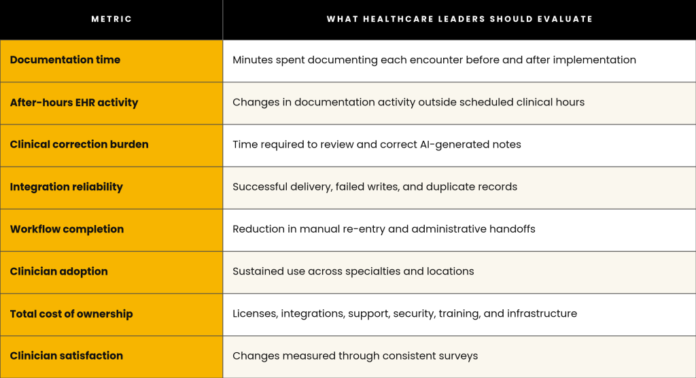
Measure documentation time, correction charges, integration failures, clinician adoption, and after-hours EHR exercise.
Develop solely when the technical and scientific efficiency meets agreed acceptance standards.
A profitable pilot proves that the know-how may match.
A profitable enterprise implementation proves that it really works reliably throughout the group’s working setting.
How Do You Measure ROI From Ambient Listening in Healthcare?
For US healthcare executives, the enterprise case must transcend the amount of notes generated.
A product that creates 1000’s of AI notes however leaves clinicians correcting paperwork and manually finishing downstream duties could ship much less worth than anticipated.
The ROI evaluation ought to take into account each advantages and prices.

A easy monetary mannequin can estimate:
Annual web profit = Verified annual working financial savings + attributable extra contribution margin − annualized implementation and working prices.
However not each recovered minute interprets into income.
Some financial savings enhance clinician expertise or cut back after-hours work with out growing appointment capability.
Equally, decreased burnout mustn’t mechanically be counted as doctor retention financial savings with out supporting proof.
The strongest ROI fashions distinguish between time recovered, prices truly prevented, and extra income genuinely realized.
Ambient Listening in Healthcare and HIPAA: What CIOs Should Deal with Earlier than Integration
Ambient AI introduces delicate knowledge flows that stretch past the present EHR.
Audio recordings, transcripts, generated notes, and scientific context could move by AI providers, cloud infrastructure, and integration platforms.
Meaning safety can’t be handled as an afterthought.
Healthcare organizations ought to confirm:
1. Which distributors and subprocessors create, obtain, keep, or transmit digital protected well being info.
2. Whether or not required enterprise affiliate agreements are in place.
3. How audio, transcripts, and generated documentation are encrypted and retained.
4. Whether or not affected person consent and recording preferences are captured appropriately.
5. How person permissions and affected person entry restrictions are enforced.
6. Whether or not AI suppliers are permitted to make use of scientific info for mannequin coaching.
7. How incidents, inaccurate information, and unauthorized entry are recognized and addressed.
The US Division of Well being and Human Companies confirms that cloud service suppliers dealing with digital protected well being info on behalf of lined entities or enterprise associates are typically enterprise associates, with corresponding HIPAA obligations.
A vendor’s assertion that its product is HIPAA-compliant shouldn’t be adequate proof that your entire built-in workflow meets the group’s obligations.
Compliance is determined by how the whole system is designed, configured, ruled, and operated.
Reference: HHS Steerage on HIPAA and Cloud Computing
How ISHIR Helps Healthcare Organizations Combine Ambient Listening AI With Current EHR Methods
Healthcare organizations don’t want one other disconnected software that provides complexity to an already fragmented IT setting.
They want options that work with current programs, respect scientific workflows, and may scale safely.
ISHIR helps healthcare organizations and HealthTech firms tackle these challenges by healthcare software program engineering, AI integration, software modernization, and interoperability-focused improvement.
Each implementation needs to be designed across the healthcare group’s particular EHR setting, scientific necessities, safety tasks, and vendor-supported interfaces.
The true alternative is to not make your current EHR out of date. It’s to make that EHR extra helpful by connecting it to the following era of healthcare AI.
Able to Make Ambient AI Work With Your Current EHR?
ISHIR helps healthcare organizations engineer safe EHR integrations, healthcare APIs, and AI-powered scientific workflows with out changing current programs.
Regularly Requested Questions About Ambient Listening in Healthcare and EHR Integration
Q. Can ambient listening AI combine with Epic with out changing the EHR?
Sure. Epic gives FHIR APIs and different interoperability capabilities that may assist third-party scientific functions. The particular integration is determined by the Epic deployment, enabled interfaces, authorization, and required documentation workflow. Organizations ought to confirm supported note-writing and overview capabilities earlier than implementation.
Q. How do you combine ambient listening AI with Oracle Well being or Cerner?
Oracle Well being Millennium gives FHIR R4 APIs that assist entry to scientific info and particular doc operations. Integration typically includes authenticated entry, affected person and encounter mapping, doc transformation, clinician overview, and permitted submission. Draft-note and final-document workflows have to be evaluated individually.
Q. Can ambient AI work with legacy EHR programs that don’t assist FHIR?
Sure, in some environments. Integration could also be potential by current HL7 v2 interfaces, vendor-supported APIs, doc import capabilities, or healthcare middleware. The accessible strategy is determined by the legacy software’s technical interfaces, vendor restrictions, and scientific workflow necessities.
Q. What’s the distinction between ambient AI documentation and EHR workflow integration?
Ambient AI documentation converts scientific conversations into draft notes. EHR workflow integration connects these notes and different permitted info to current scientific programs. It additionally includes affected person identification, encounter mapping, authorization, overview, supply monitoring, and potential downstream workflow coordination.
Q. Does SMART on FHIR mechanically allow ambient AI to jot down scientific notes?
No. SMART on FHIR helps standardized software authorization and integration capabilities, however precise write operations depend upon the EHR’s supported APIs, scopes, and configuration. A profitable SMART launch doesn’t assure that an software can create unsigned notes, place orders, or full scientific workflows.
Q. How lengthy does ambient AI EHR integration take?
There isn’t a dependable common timeline. A restricted integration utilizing current permitted interfaces could also be considerably less complicated than deploying throughout a number of EHR platforms. Complexity is determined by vendor approvals, API availability, safety assessments, workflow configuration, scientific testing, and legacy system limitations. An integration feasibility evaluation ought to set up reasonable scope and supply milestones.
Q. Is ambient listening in healthcare HIPAA-compliant?
Ambient listening know-how shouldn’t be mechanically HIPAA-compliant just because it’s designed for healthcare. Compliance is determined by how affected person info is captured, transmitted, processed, saved, accessed, and ruled. Required enterprise affiliate agreements, safety safeguards, privateness insurance policies, and relevant consent necessities have to be evaluated throughout the whole resolution.
Q. Can ambient AI mechanically create prescriptions, orders, and referrals?
Ambient AI could possibly extract scientific intent and put together structured info for supported workflows. Nonetheless, creating or submitting scientific orders requires applicable EHR capabilities, authorization, validation, {and professional} oversight. Excessive-risk scientific actions shouldn’t be executed solely from an unverified AI interpretation of a dialog.
Q. Ought to hospitals construct customized ambient AI options or purchase an current product?
Healthcare organizations ought to consider current options first when their necessities are primarily commonplace scientific documentation. Customized improvement could also be justified when organizations want specialised workflows, proprietary performance, distinctive integrations, or differentiated HealthTech merchandise. A build-versus-buy evaluation ought to take into account scientific security, integration prices, possession, scalability, and long-term upkeep.
Q. What ought to healthcare CIOs consider earlier than scaling ambient AI throughout hospitals?
They need to consider EHR compatibility, scientific documentation accuracy, workflow integration, knowledge safety, clinician adoption, interface reliability, complete price of possession, and measurable working outcomes. An important query is whether or not the know-how reduces your entire scientific documentation burden relatively than merely producing notes sooner.

